Categories
Excepteur sint ocaecat cupidatat exo proident sunt culpa.
Excepteur sint ocaecat cupidatat exo proident sunt culpa.
It is a group of chronic eye disease that affects the optic nerve and causes loss of vision. Aqueous humour(AH) is the fluid secreted in the eye that is needed to maintain eye health. As much as AH flows into the eye, the same quantity should be draining out as well. It occurs via a channel called trabecular meshwork in the angle of the eye. If the drainage doesn’t happen appropriately then the fluids accumulate inside the eye creates pressure and causing the intraocular pressure (IOP) to rise. Normal IOP is between 10-21mm Hg. It is never a single number and never constant. IOP also shows variation during the day and night. The optic nerve is the part of the retina, made of millions of nerves affected by raised IOP. As the nerve fibres get affected, one develops blind areas in their visual field and loses vision. One may not notice the loss of vision unless very sensitive until most of the optic nerves are affected. If the reserves of optic nerve is lost then the person becomes blind.
Note - Intraocular pressure in common terms is eye pressure which is needed to keep the eyeball in particular shape and health Akin to the blood pressure, it is the pressure inside the eyeball.
When the drainage angle is open anatomically but not functionally well.
When the drainage angle is closed
These are subjects with open angles and normal IOP range but have optic nerve affected due to various non IOP related factors.
Glaucoma is a silent disease and most people do not have any symptoms until the optic nerve damage is quite severe and vision is affected as blind spots in the visual field. Subjects with angle closure have some early symptoms like coloured halos, blurred vision, mild headaches and eye pain. These occur intermittently initially but the symptoms get to occur too often and persistently enough to cause discomfort in doing daily activities. An acute attack of angle closure presents with
Some predisposed subjects are at higher risk than the normal population for getting glaucoma. They are
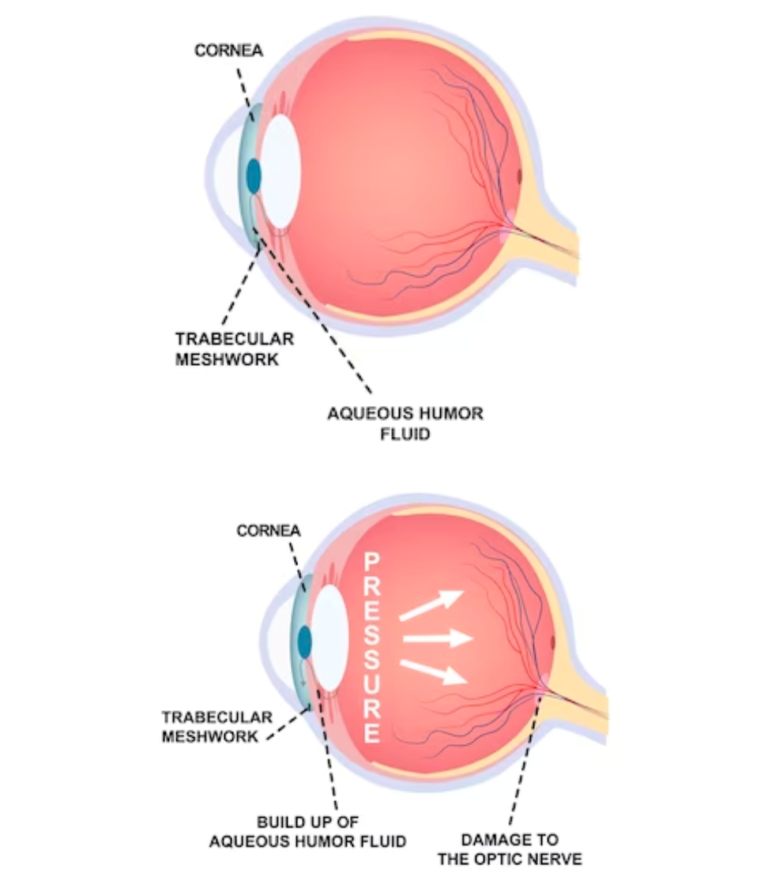
The only sure way to get diagnosed glaucoma is by a comprehensive eye examination by glaucoma trained ophthalmologist.
More than just checking IOP is required to diagnose glaucoma. It needs an ophthalmologist to inspect the eye’s drainage angle, examine the optic nerve head, test the visual field and measure the cornea thickness
Medications, and laser treatment can help in early- moderate cases. But surgery is the treatment if other two options fail to achieve desired IOP to slow down the damage further. Glaucoma damage that has occurred is NOT REVERSIBLE, it cannot be completely cured but treatable.